India's Iron Ore Imports Hit 7-Year High Amid Domestic Shortages

Overview
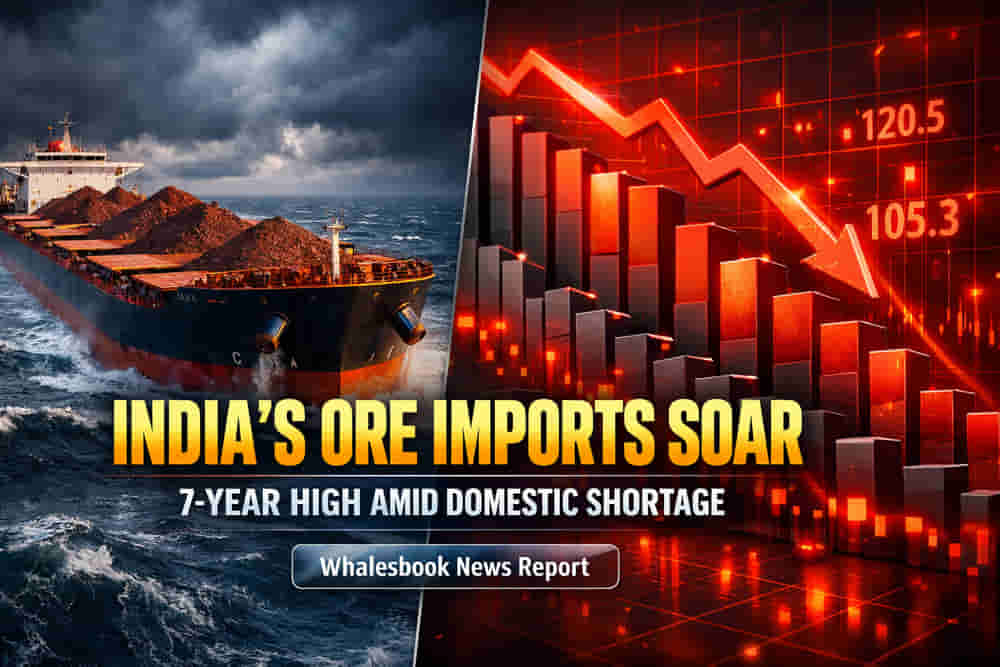
India's iron ore imports surged to a seven-year high in 2025, driven by a global ore glut, softer international prices, and domestic supply constraints. Steelmakers, led by JSW Steel, are increasingly looking overseas, raising concerns about raw material security as domestic steel capacity expands.
Stocks Mentioned
Record Imports Shake Up Indian Steelmaking
India's iron ore imports have reached a seven-year peak, fundamentally altering the nation's raw material economics. Steelmakers are turning to overseas sources in significant volumes, a trend driven by a global glut of high-grade ore, falling international prices, and logistical hurdles. This pivot raises critical questions about raw material security as India's steel production capacity expands aggressively.
In calendar year 2025, India imported 12.2 million tonnes of iron ore, nearly doubling the previous year's volume, according to commodities market intelligence firm Big Mint. Brazil and Oman emerged as the largest suppliers, with JSW Steel alone accounting for approximately 80% of the total imported quantity.
Shifting Import Economics
Company-specific supply issues and broader market pricing dynamics propelled the import surge. JSW Steel's surrender of its Jajang mines in Odisha in 2025 led to a significant drop in its domestic production. To compensate, the company substantially increased its imports.
Lower global prices made overseas purchases economically viable. Iron ore hovered below $100 per tonne at the start of 2025, creating a favorable arbitrage opportunity for imports. Even after factoring in logistics, domestic ore prices are often comparable or only marginally cheaper. However, imports provide the advantage of uniform quality and large volumes from a single source, which domestic miners, often operating under long-term agreements or lacking bulk cargo capacity, cannot consistently match. High transport costs further incentivized west coast mills to import from the Middle East.
Quality Crunch Compounds Issues
Beyond immediate price and logistics, experts point to a structural decline in the quality of India's domestic ore. This is occurring simultaneously with increased global availability of high-grade supply from new and expanded mines in Guinea, Australia, and Brazil. This mismatch means India faces a tighter supply of high-grade ore domestically, while international markets offer better quality at competitive prices.
Steel production capacity grew 9.5% to 163 million tonnes in 2025, while domestic iron ore output rose 4% to 295 million tonnes. Despite increased output, the availability of high-grade ore for steelmaking has tightened. Global prices have also fallen over 20%, making imports more attractive, especially for coastal plants.
Policy Pains and Future Outlook
The trend is concerning, as domestic raw material production lags behind steel growth, risking shortages that could hinder national policy targets. While the government has explored measures like capping auction premiums and reallocating non-operational mines, reforms have stalled due to resistance. Approximately 135 iron ore mines have been auctioned since 2015, but only about 35 are operational.
Some analysts argue this is purely a pricing issue, not a fundamental resource scarcity. They believe imports will remain elevated in the near term as new greenfield mines come online. Global prices are now above $100 per tonne, and the rupee has weakened, which may slightly temper import levels in 2026. However, temporary disruptions like the monsoon in 2025 are seen as short-term, with availability expected to improve as mid-sized players ramp up production.